
When people first start comparing automotive scan tools, they usually look for the obvious things: can it read fault codes, clear warning lights, show live data, and support the vehicle brands they work on?
But once you move beyond basic OBD2 scanners, one feature becomes especially important for real diagnostics: bi-directional control.
For workshops, mobile mechanics, and serious technicians, bi-directional control can be the difference between guessing what is wrong and actually commanding a vehicle system to prove it. It is one of the key reasons professional scan tools cost more than basic code readers, and it is a feature worth understanding before choosing your next diagnostic tool.
What does bi-directional control mean?
Bi-directional control means the scan tool can communicate with the vehicle in two directions.
A basic OBD2 scanner mainly receives information from the car. It can read diagnostic trouble codes, view some live data, and clear faults. A bi-directional scan tool can go further. It can receive information from the vehicle and also send commands back to the vehicle’s control modules.
That means the scan tool may be able to activate components, run system tests, and command certain functions without physically operating the part.
This is why bi-directional control is also commonly called:
- Active test
- Actuator test
- Functional test
- System test
- Component activation
For example, instead of only reading a fault code related to a cooling fan, a technician may be able to use a bi-directional scan tool to command the fan on and off. If the scan tool sends the command but the fan does not respond, the technician can investigate the fan, relay, wiring, fuse, or module control circuit more directly.
For a background understanding of OBD systems, Geotab explains that on-board diagnostics give technicians access to subsystem information for monitoring and analysing repair needs. You can also read a broader explanation of bi-directional control from Innova, which describes it as sending and receiving information between two devices.

Why bi-directional control matters in real diagnostics
Modern vehicles are controlled by multiple electronic modules. Engine, transmission, ABS, SRS, body control, steering, ADAS, battery systems, and comfort systems may all communicate electronically.
A fault code tells you where to start, but it does not always tell you which part is faulty.
For example, a DTC may point to a circuit, a sensor, or a system condition. Without active testing, the technician may still need to manually test multiple components. With bi-directional control, the scan tool can help narrow the issue faster by commanding specific actions.
Common examples include:
- Turning cooling fans on and off
- Activating fuel injectors
- Operating ABS pump motors or solenoids
- Testing EVAP purge valves
- Cycling door locks or windows
- Triggering relays
- Running throttle body or idle relearn functions
- Performing brake bleeding functions on supported vehicles
- Testing lights, wipers, horns, and other body components
This can reduce diagnostic time, avoid unnecessary parts replacement, and improve workshop efficiency.
Bi-directional scan tool vs basic OBD2 scanner
A basic OBD2 scanner is still useful. It is good for reading engine fault codes, clearing simple warning lights, and checking emissions-related data. For DIY users, that may be enough.
But for a workshop, a basic code reader can quickly become limiting.
A full system diagnostic scanner with bi-directional control can access more vehicle modules, perform active tests, view live data, support service functions, and in some cases provide coding, matching, programming, topology mapping, or guided functions.
Here is the simple difference:
| Feature | Basic OBD2 Scanner | Bi-Directional Scan Tool |
| Read engine codes | Yes | Yes |
| Clear codes | Yes | Yes |
| View live data | Limited or basic | More advanced |
| Access all systems | Usually no | Yes, depending on tool and vehicle |
| Active tests / actuator tests | Usually no | Yes, depending on vehicle support |
| Service resets | Limited | More advanced |
| Coding / matching | Usually no | Available on selected professional tools |
| Best for | Simple DIY checks | Workshops and professional diagnostics |
Important note: support depends on the vehicle
Bi-directional control is powerful, but it is not identical on every vehicle.
The exact active tests available depend on the vehicle make, model, year, system, software coverage, and the diagnostic tool being used. A function available on one vehicle may not be available on another.
That is why professional workshops should not only ask, “Does this scan tool have bi-directional control?” A better question is:
Does this scan tool support the vehicle systems, protocols, brands, and functions my workshop actually needs?
This is where the LAUNCH X-431 range becomes useful, because different models suit different workshop sizes, budgets, and diagnostic needs.
Recommended LAUNCH scan tools with bi-directional control
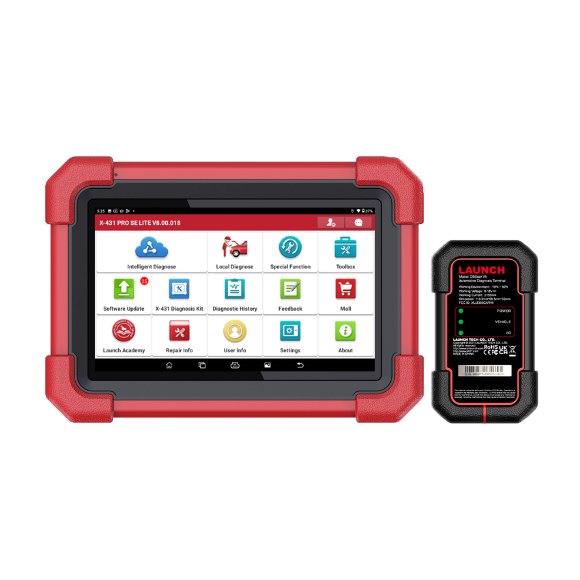
LAUNCH X-431 PRO SE Lite: Best entry point for passenger car workshops
If you want a professional scan tool without jumping straight into flagship pricing, the LAUNCH X-431 PRO SE Lite is a strong starting point.
It is designed for workshops focusing mainly on passenger vehicles and offers full system diagnostic functions including reading and clearing DTCs, live data streaming, bi-directional control, coding and matching.
It also supports wide OE-level coverage for many U.S., Asian, and European vehicles from 1996 and newer, with 95 diagnostic software packages currently available and continuously updated.
This makes it a practical choice if you are searching for:
- Professional automotive scan tool Australia
- OBD2 scanner with bi-directional control
- Full system diagnostic scanner
- LAUNCH X-431 scan tool for passenger cars
- ECU coding scan tool
The PRO SE Lite is also compatible with add-on modules including VSP-600, X-431 TSGUN, BST360 Bluetooth Battery Tester, and X-PROG 3, giving workshops room to expand their diagnostic setup over time.
Best for: small to medium workshops, passenger car repairers, technicians upgrading from basic OBD2 scanners.
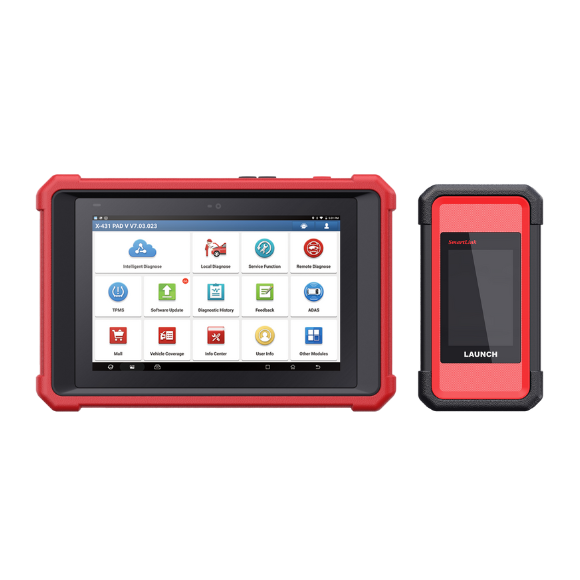
LAUNCH X-431 PAD5 Link: Best for advanced workshops wanting ADAS, programming, and heavy-duty expansion
The LAUNCH X-431 PAD5 Link is a high-end professional diagnostic tool built for more advanced diagnostic work.
It includes full diagnostic functions such as read and clear DTCs, live data streaming, bi-directional control, coding, programming, and more. It also supports topology mapping, allowing technicians to visually check DTCs and communication status across vehicle systems.
For workshops looking to grow into more advanced services, the PAD5 Link is especially attractive because it supports ADAS calibration functions, TPMS service, guided functions for Volkswagen and Audi, and light, medium, and heavy-duty vehicle diagnosis with optional configuration.
It also supports modern communication protocols including CAN, CANFD, DoIP, and standards such as J2534, D-PDU, and RP1210.
That makes it a strong match for search terms like:
- Advanced diagnostic scan tool
- CANFD DoIP scan tool
- J2534 diagnostic tool
- ADAS calibration scan tool
- Professional workshop scan tool
- Bi-directional scan tool with programming
Its IP65 waterproof and dustproof case also makes it more suitable for workshop environments where tools need to survive daily use.
Best for: established workshops, advanced diagnostic technicians, repairers wanting ADAS, coding, programming, TPMS, and optional heavy-duty capability.
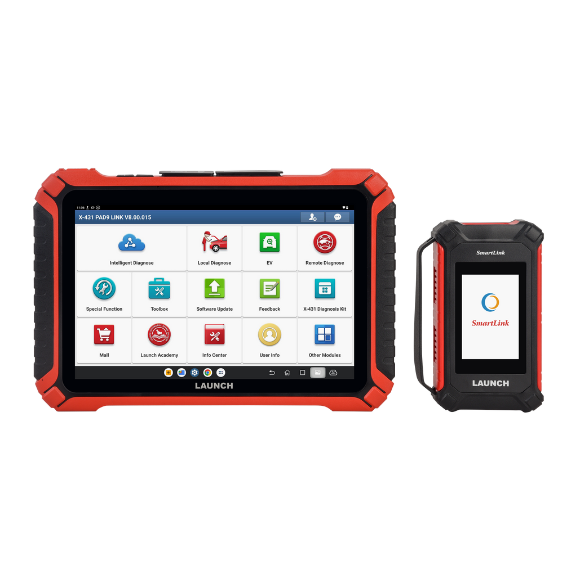
LAUNCH X-431 PAD9 Link: Best flagship choice for modern, multi-service workshops
If your workshop wants the top-end option, the LAUNCH X-431 PAD9 Link is the flagship tool to consider.
The PAD9 Link is designed for auto repair shops working across passenger cars, commercial vehicles, and new energy vehicles. It supports 150+ passenger car brands, 110+ commercial vehicle brands as an optional package, and 140+ new energy vehicle brands as an optional package.
Its key diagnostic features include reading and clearing DTCs, remote diagnosis, bi-directional control, live data graphing, wireless software updates, advanced coding and programming, topology mapping, SGW access, and multi-system data streams.
One of its biggest advantages is speed. The PAD9 Link supports multi-channel high-speed scanning, around 10 times faster according to the product listing. It also comes with the SmartLink C V3.0 VCI for enhanced wireless communication and a more secure connection.
For workshops that want to position themselves for newer vehicles, the PAD9 Link also supports CAN, CANFD, DoIP, and J2534, with optional ADAS calibration and the LAUNCH AI software now available on the tool.
This makes it highly suitable for keywords such as:
- Flagship diagnostic scan tool
- Professional scan tool for workshops
- Full system bi-directional scanner
- Truck diagnostic scan tool
- New energy vehicle diagnostic tool
- LAUNCH PAD9 Link Australia
- CANFD and DoIP scan tool
Best for: high-volume workshops, multi-brand repairers, diagnostic specialists, workshops handling passenger, commercial, and new energy vehicles.
Final thoughts
Bi-directional control is one of the most important features to look for when moving from a basic OBD2 scanner to a professional automotive diagnostic tool.
Instead of only reading what the vehicle reports, a bi-directional scan tool lets technicians actively test components and systems. This helps confirm faults faster, reduce guesswork, and improve repair confidence.
For Australian workshops, the LAUNCH X-431 range offers several practical options depending on budget and diagnostic needs. Whether you are upgrading into professional diagnostics with the X-431 PRO SE Lite, expanding advanced workshop services with the X-431 PAD5 Link, or investing in a flagship solution with the X-431 PAD9 Link, bi-directional control is a feature worth having.
Explore the range at Launch Online and choose the scan tool that matches the vehicles, systems, and services your workshop works with every day.

